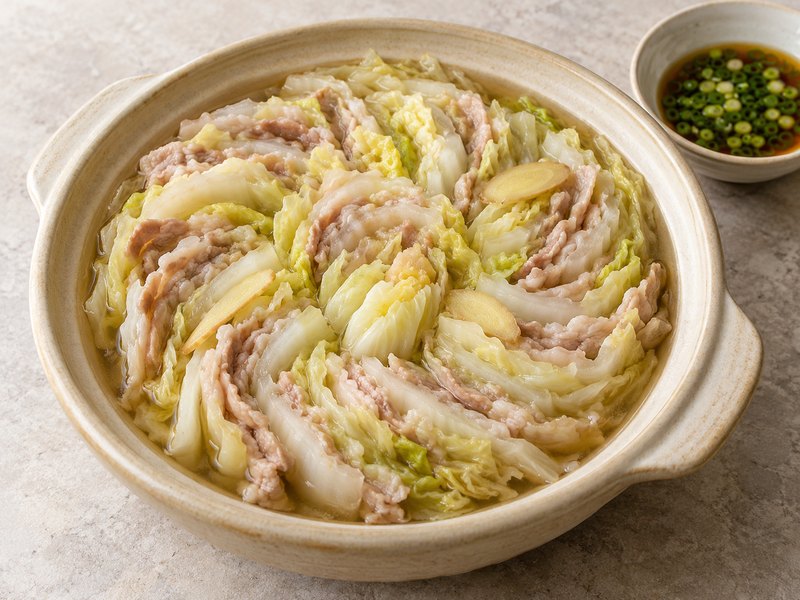
Japanese Pork and Napa Cabbage Hot Pot
Sandwich the thin pork belly with cabbage leaves, arrange it vertically into a ring, and boil it in ginger-flavored stock until soft.
- Total time
- 50 minutes
- Servings
- 3 servings
- Flavor
- Savory
- Equipment
- Wide mouth soup pot
Per serving, approx. 630 kcal
Key ingredients: Chinese cabbage Pork belly Ginger
Edited and maintained by Pantry & Plate
Main course · Updated
AI-generated dish illustration. Read our editorial notes.
Estimated protein per serving: 14.6 g.
Prepare the ingredients
Ingredients for 3 servings. Quantities scale with your serving count.
| Food ingredients | Dosage |
|---|---|
| Chinese cabbage | (850 g) |
| Pork belly | (320 g) |
| Ginger | (15 g) |
| Japanese dashi stock | (550 ml) |
| Soy sauce | (20 ml) |
| Mirin | (15 ml) |
| Scallions | (15 g) |
| Rice vinegar | (15 ml) |
The amount of ingredients, step brackets and calories are adjusted according to the number of people; the cooking time is based on the basic 3 person portion. Please cook in batches for multiple people.
When there are decimals when measuring by "piece", it can be divided by weight; eggs are based on about 50 grams of shelled beaten eggs for reference. Dishes that need to be formed whole can be prepared in basic portions and divided into meals. The molding quantities and molds in the steps are based on the basic portion. When the number of people increases or decreases, the molding quantities will be adjusted accordingly or made in batches.
Calorie details and calculation basis
The whole dish takes approx. 1890 kcal · Approximately 630 kcal per person
| Chinese cabbage | 136 kilocalories |
| Pork belly | 1658 kilocalories |
| Ginger | 12 kilocalories |
| Japanese dashi stock | 28 kilocalories |
| Soy sauce | 12 kilocalories |
| Mirin | 39 kilocalories |
| Scallions | 5 kilocalories |
| Rice vinegar | 3 kilocalories |
Estimated based on the edible weight of the ingredients and the listed oils, sugars, and sauces, without deducting remaining oil, discarded soup, or alcohol evaporation. Data reference USDA SR28and the food material reference data on this site, some are approximate values for similar food materials. The brand and actual serving size affect the results and are not actual measured values.
How to make Japanese Pork and Napa Cabbage Hot Pot
Instructions for 3 servings. Add each ingredient once unless a step specifies a divided amount. Cooking times are estimates; adjust for doneness and batch size.
Wash the cabbage and slice the pork
Wash and drain Chinese cabbage (850 grams) leaf by leaf, peel and boneless pork belly (320 grams) into thin slices, about 2 mm thick; slice ginger (15 grams), and cut green onions (15 grams) into thin rings.
Place a piece of cabbage on top of a layer of meat slices
Place a piece of cabbage on top of a layer of meat slices, then cover it with another piece of cabbage, stacking it into 4 to 5 layers; cut it crosswise into sections about 5 cm long.
Arrange the cut side up in a circle
Arrange the cut side up in a circle and vertically along the edge of a soup pot with a diameter of about 22 cm. The remaining scattered cabbage is stuffed into the gaps, and ginger (15 grams) slices are placed between the layers.
Mix Japanese dashi stock, soy sauce
Mix Japanese dashi stock (550 ml), soy sauce (20 ml), and mirin (15 ml) into the pot; bring to a boil over medium heat, then cover, turn to medium-low heat and simmer for 15 to 18 minutes.
Check the pork and cabbage for doneness
The thickest cabbage stems should be soft and transparent, the meat slices should be fully cooked, and the center should be at least 63 ℃; maintain a slight boil and cook for 3 minutes.
Mix the scallions with the rice vinegar and divide into dipping bowls
Mix the scallions (15 g) with the rice vinegar (15 ml) and divide into dipping bowls. Place the hot pot on a heatproof trivet. Lift out the cabbage and pork to dip, and serve the hot broth alongside.
Cooking tips
- The slices should be arranged tightly so that they can still maintain the layer after being shrunk after cooking; the pork belly is calculated by peeled and boneless edible weight. Raw meat listed is based on boneless edible portion weight.
- The sauce or stock itself may contain salt. Mix it according to the steps first, and then adjust the salt amount based on the saltiness of the selected product.
Find a video and follow along
Jump to the platform to search for a tutorial with the same name. The video version and ingredients may be different.
If you have allergies or dietary restrictions, please check the packaging of all ingredients and sauces and pay attention to cross-contact. Handle raw and cooked ingredients separately.