Korean Spicy Noodles
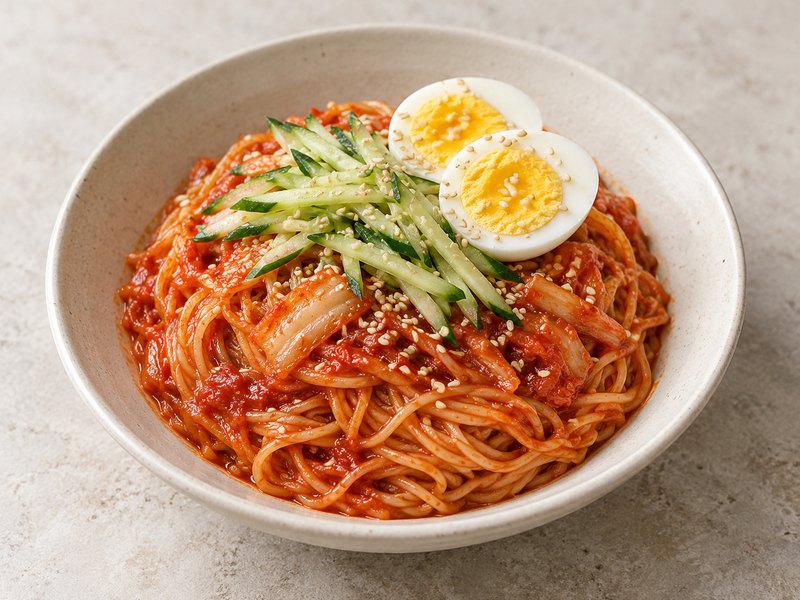
Thin noodles wrapped in kimchi hot sauce, served with cucumber shreds and hard-boiled eggs, sour, spicy and refreshing.
- Total time
- 30 minutes
- Servings
- 2 servings
- Flavor
- Spicy
- Equipment
- Soup pot, noodle bowl
Per serving, approx. 630 kcal
Key ingredients: Noodles Korean kimchi Cucumbers
Edited and maintained by Pantry & Plate
Main course · Updated
AI-generated dish illustration. Read our editorial notes.
Estimated protein per serving: 22.3 g.
Prepare the ingredients
Ingredients for 2 servings. Quantities scale with your serving count.
| Food ingredients | Dosage |
|---|---|
| Noodles | (220 g) |
| Korean kimchi | (150 g) |
| Cucumbers | (150 g) |
| Eggs | (2 pcs) |
| Gochujang (Korean chili paste) | (35 g) |
| Rice vinegar | (18 ml) |
| Sugar | (12 g) |
| Sesame oil | (12 g) |
| Garlic | (6 g) |
| Toasted white sesame seeds | (8 g) |
The amount of ingredients, step brackets and calories are adjusted according to the number of people; the cooking time is based on the basic 2 person portion. Please cook in batches for multiple people.
When there are decimals when measuring by "piece", it can be divided by weight; eggs are based on about 50 grams of shelled beaten eggs for reference. Dishes that need to be formed whole can be prepared in basic portions and divided into meals. The molding quantities and molds in the steps are based on the basic portion. When the number of people increases or decreases, the molding quantities will be adjusted accordingly or made in batches.
Calorie details and calculation basis
The whole dish takes approx. 1265 kcal · Approximately 630 kcal per person
| Noodles | 783 kilocalories |
| Korean kimchi | 23 kilocalories |
| Cucumbers | 23 kilocalories |
| Eggs | 143 kilocalories |
| Gochujang (Korean chili paste) | 84 kilocalories |
| Rice vinegar | 3 kilocalories |
| Sugar | 46 kilocalories |
| Sesame oil | 106 kilocalories |
| Garlic | 9 kilocalories |
| Toasted white sesame seeds | 45 kilocalories |
Estimated based on the edible weight of the ingredients and the listed oils, sugars, and sauces, without deducting remaining oil, discarded soup, or alcohol evaporation. Data reference USDA SR28and the food material reference data on this site, some are approximate values for similar food materials. The brand and actual serving size affect the results and are not actual measured values.
How to make Korean Spicy Noodles
Instructions for 2 servings. Add each ingredient once unless a step specifies a divided amount. Cooking times are estimates; adjust for doneness and batch size.
Pour eggs into a pot with cold water
Pour eggs (2 pieces) into a pot with cold water, bring to a boil, then turn down to low heat and simmer for 10 minutes until fully cooked, cool, peel and cut in half, pour away the water from the boiled eggs (2 eggs).
Julienne the cucumber into strips
Julienne the cucumber (150 g) into 2 mm strips. Chop the kimchi (150 g) into 1 cm pieces and finely grate the garlic (6 g). Keep all the liquid from the kimchi (150 g total).
Mix gochujang
Mix gochujang (35 g), rice vinegar (18 ml), sugar (12 g), sesame oil (12 g) and garlic (6 g) in a large bowl, stir until the sugar (12 g) is basically dissolved, then add kimchi (Korean kimchi 150 g).
Boil water in a soup pot
Boil water in a soup pot, add thin noodles (220 grams) according to the package and cook for about 4 to 6 minutes until there is no hard core; take out and rinse with cold drinking water, drain thoroughly, and discard the cooking water.
Toss the noodles with the sauce
Noodles (220 grams) are immediately added to the sauce bowl and stirred with chopsticks for 1 minute until each noodle is evenly coated with red sauce.
Divide into bowls
Divide into 2 bowls, add shredded cucumbers (150 grams) and cooked eggs (2 pieces), sprinkle with toasted white sesame seeds (8 grams), mix and eat immediately to maintain the texture of the noodles (220 grams).
Cooking tips
- Prepare all the side dishes and sauce before cooking the noodles to prevent the noodles from sticking together for a long time.
- Different brands and thicknesses of noodles have different water absorption and cooking times. Please refer to the packaging instructions for cooking or soaking times.
- The sauce or stock itself may contain salt. Mix it according to the steps first, and then adjust the salt amount based on the saltiness of the selected product.
Find a video and follow along
Jump to the platform to search for a tutorial with the same name. The video version and ingredients may be different.
If you have allergies or dietary restrictions, please check the packaging of all ingredients and sauces and pay attention to cross-contact. Handle raw and cooked ingredients separately.