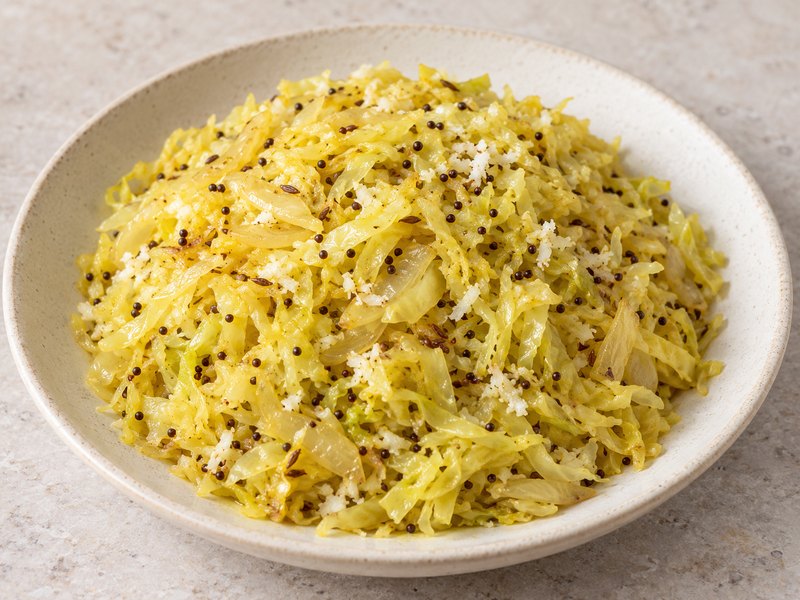
Indian Coconut Cabbage (homestyle)
Stir-fry finely chopped cabbage with mustard seeds and grated coconut. It has a soft texture without being soupy.
- Total time
- 30 minutes
- Servings
- 3 servings
- Flavor
- Light
- Equipment
- Wok
Per serving, approx. 165 kcal
Key ingredients: Cabbage Onions Unsweetened desiccated coconut
Edited and maintained by Pantry & Plate
Side dish · Updated
AI-generated dish illustration. Read our editorial notes.
Estimated protein per serving: 3.1 g.
Prepare the ingredients
Ingredients for 3 servings. Quantities scale with your serving count.
| Food ingredients | Dosage |
|---|---|
| Cabbage | (450 g) |
| Onions | (70 g) |
| Unsweetened desiccated coconut | (30 g) |
| Mustard seeds | (2 g) |
| Cumin seeds | (1 g) |
| Turmeric powder | (1 g) |
| Salt | (3 g) |
| Cooking oil | (15 g) |
| Water | (50 ml) |
The amount of ingredients, step brackets and calories are adjusted according to the number of people; the cooking time is based on the basic 3 person portion. Please cook in batches for multiple people.
When there are decimals when measuring by "piece", it can be divided by weight; eggs are based on about 50 grams of shelled beaten eggs for reference. Dishes that need to be formed whole can be prepared in basic portions and divided into meals. The molding quantities and molds in the steps are based on the basic portion. When the number of people increases or decreases, the molding quantities will be adjusted accordingly or made in batches.
Calorie details and calculation basis
The whole dish takes approx. 490 kcal · Approximately 165 kcal per person
| Cabbage | 113 kilocalories |
| Onions | 28 kilocalories |
| Unsweetened desiccated coconut | 198 kilocalories |
| Mustard seeds | 10 kilocalories |
| Cumin seeds | 4 kilocalories |
| Turmeric powder | 3 kilocalories |
| Salt | 0 kilocalories |
| Cooking oil | 133 kilocalories |
| Water | 0 kilocalories |
Estimated based on the edible weight of the ingredients and the listed oils, sugars, and sauces, without deducting remaining oil, discarded soup, or alcohol evaporation. Data reference USDA SR28and the food material reference data on this site, some are approximate values for similar food materials. The brand and actual serving size affect the results and are not actual measured values.
How to make Indian Coconut Cabbage (homestyle)
Instructions for 3 servings. Add each ingredient once unless a step specifies a divided amount. Cooking times are estimates; adjust for doneness and batch size.
Cut cabbage into thin strips
Cut cabbage (450 grams) into thin strips of about 3 mm, then cut crosswise into short sections; cut onions (70 grams) into fine dices.
Use half of the water to moisten the desiccated coconut and let it sit
Use half of the water (25 ml, this step) to moisten the desiccated coconut (30 gram) and let it sit for 5 minutes; this will replenish the moisture needed for the desiccated coconut (30 gram).
Add cooking oil to the wok
Add cooking oil (15 grams) to the wok over medium-low heat, add mustard seeds (2 grams) and cover the pot for about 30 seconds. Add cumin seeds (1 grams) after hearing a slight pop.
Add onion and stir-fry
Add onion (70 g) and stir-fry for 3 minutes until translucent. Add turmeric powder (1 g), cabbage (450 g) and salt (3 g), mix well for 1 minute.
Pour in the remaining water
Pour in the remaining water (25 ml, remaining), cover and simmer over low heat for 6-8 minutes, stirring halfway through, until the shredded vegetables are cooked and soft but still retain their shape.
Add the moistened desiccated coconut
Add the moistened desiccated coconut (30 g) and stir-fry over medium heat for 2 minutes, until the water (50 ml total allowance) has been absorbed or evaporated and no liquid pools in the pan. Serve hot.
Cooking tips
- This is a homemade version that omits curry leaves and uses dried coconut; moistening the coconut will prevent it from burning when put into the pan.
- Prepare all the ingredients that need to be cut and mixed before starting the fire; it is recommended to cook in batches for multiple people to avoid overfilling the pot and causing a large amount of water.
- The amount of evaporation from pots is different from the amount of water absorbed by the food. Pay attention to the amount of water when cooking; the water used for cleaning and blanching should be sufficient to handle the food.
Find a video and follow along
Jump to the platform to search for a tutorial with the same name. The video version and ingredients may be different.
If you have allergies or dietary restrictions, please check the packaging of all ingredients and sauces and pay attention to cross-contact. Handle raw and cooked ingredients separately.